
Revolutionary Roots of Morgan County, Georgia | America 250
How We the People - Revolutionary War Veterans, Settlers, and Communities - Shaped the Land, Ideals, and Institutions of Madison and Morgan County
The founding of Morgan County and the city of Madison is ultimately a story of We the People: Indigenous communities who lived on and stewarded this land for centuries; Revolutionary War veterans and settlers who arrived through land lotteries and migration; and the many individuals – free and unfree – whose labor, decisions, and sacrifices shaped a new community. The American Revolution did more than secure independence. It influenced where people settled, how land was distributed, who held power, and how a society defined itself.
As America welcomes its 250th anniversary, we invite visitors to look beyond 1776 to discover how Revolutionary service, post-war settlement, and democratic ideals helped form Morgan County’s landscape, economy and civic life. From early settlement patterns and agricultural transformation to architecture inspired by classical democracy, educational institutions, and the veterans whose final resting places remain here today, the legacy of the Revolution is still visible across Madison and Morgan County.
History Here Didn’t Start in 1776: A Land Inhabited for Thousands of Years
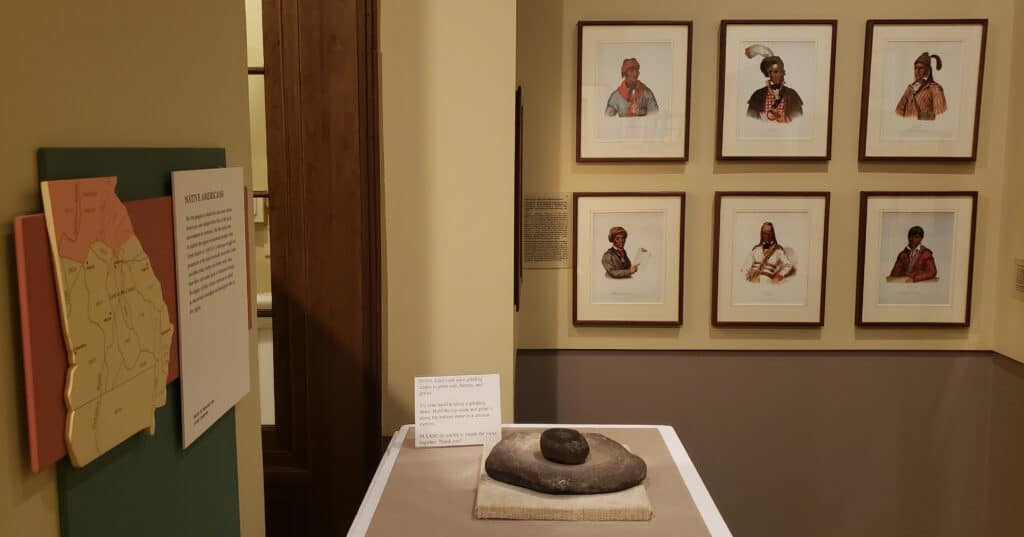
Although the official incorporation of Morgan County was in 1807, the unincorporated beginnings date back hundreds and thousands of years. Many Native American groups prospered here – likely until the first European contact in the 1540s. As the Revolutionary War created contention within the Muscogee (Creek) Nation, splitting the group between Upper and Lower Creek, it also pushed Native Americans from the area due to increased demand for Native lands.
The settlers of Morgan County were likely drawn to the diverse environment of wetlands, forests and grasslands that made up this area. Because of the presence of wetlands in the bottomlands of the county, settlers had access to a flourishing habitat.
As for the forests and grasslands, the story of Buckhead’s founding, one of Morgan County’s first recorded white settlements, points to the importance of these environments for settlement. The legend goes that Booth Fitzpatrick and his dog were trespassing into Muscogee (Creek) lands across from Greene County where they discovered the fertility of the land and the abundance of game in the area. After telling friends and family, an influx of white settlers began establishing homes and farms here at least as early as 1795.
A notable settlement was that of Booth’s brother, Private Benjamin Fitzpatrick, who fought in the American Revolution, and whose grave lies here today. Settlements in this area became legal following Georgia’s first land lottery in 1805, the first of its kind in the United States, which redistributed land gained from the Yazoo and Pine Barren Land Frauds as well as land cessions from the Muscogee (Creek) Nation.
Shaped by the Revolution: A County and Town Emerge
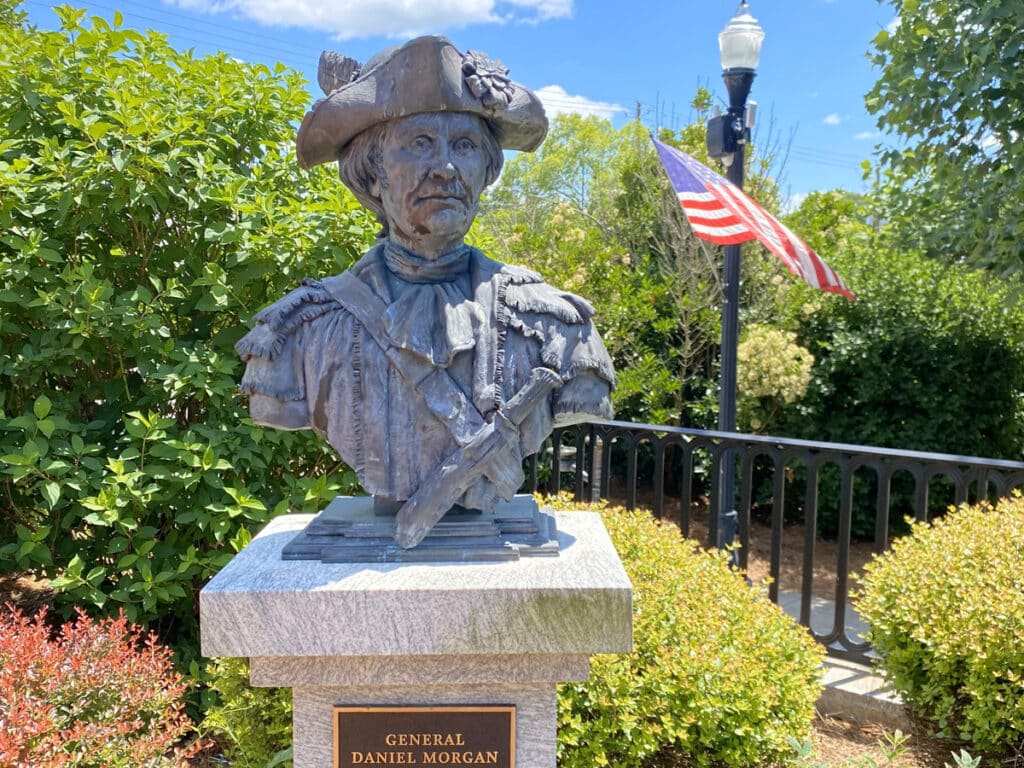
Originally incorporated within Baldwin County in 1803, Morgan County became independent in 1807. Named for Revolutionary War Hero General Daniel Morgan, The Magazine Antiques notes some 62 settlers of Morgan County served under General Morgan during the Revolutionary War.
The city of Madison was established not long after Morgan County. Incorporated in 1809, the city was named after the Founding Father James Madison who served as the fourth president of the United States. Functioning as the county seat, Madison started as a stop along the Stagecoach route from Charleston to New Orleans and residence to planters’ families. But the revolutionary roots of Madison and Morgan County reach further. Because of the impact revolutionary settlers had on the land, architecture and education, their histories are prevalent to this day.
From Forests to Farmland

Although the settlers had access to plentiful resources, they largely participated in subsistence farming at first. Soon enough, however, Morgan County harbored a bustling cotton farming economy. Still today, farming and utilizing grasslands is essential to Morgan County’s economy. Almost five thousand people work in agriculture in Morgan County, and in 2022, the agricultural economy amassed more than half a billion dollars.
Madison Grows With the Wealth of King Cotton
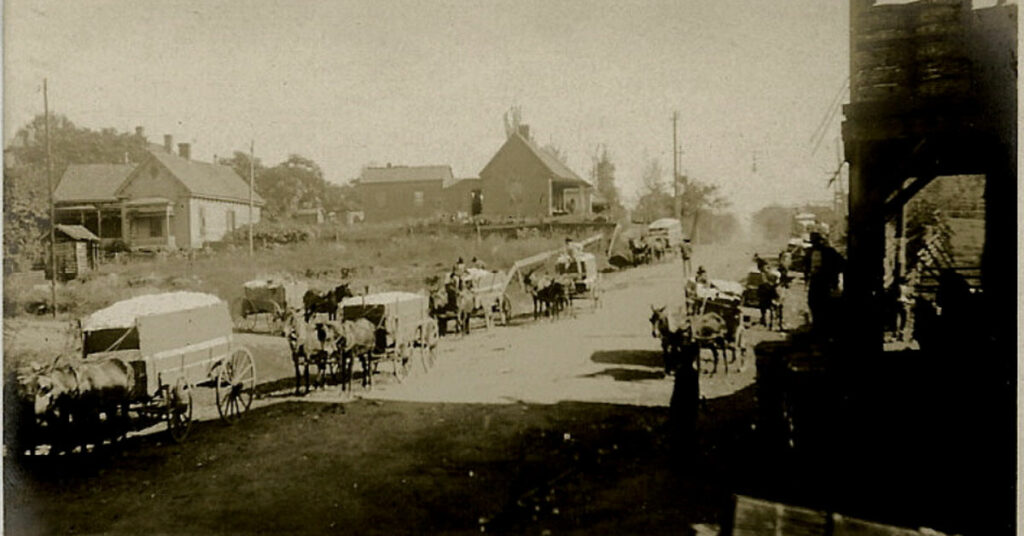
Madison was in the middle of it all as the commercial center abundant with cotton planters, small farmers and townspeople. The Planter class quickly grew throughout the early 1800’s, amassing wealth through multiple avenues not least of which was through plantations sprawled across the county worked by hundreds of enslaved laborers.
Nearly half of Morgan County’s residents were enslaved laborers as early as 1820, with that number reaching 70 percent of the county’s almost 10,000 people by the 1860 census. After the end of the Civil War and the substantial economic loss of forced labor, the tenant farming system rose to prominence, sustaining the cotton industry into the 20th century.
The Architecture of a Democratic Nation: A Uniting Key

While walking through the Madison Historic District, visitors are often astounded by the abundance of historic homes displaying a diverse blend of architectural styles. Many lie close in date to the founding of the city and still exist today due to the commitment of Madisonian citizens like former Mayor Joshua Hill – popularly touted as the man who saved Madison from Sherman’s March to the Sea – and those on the Historic Preservation Commission.
At the time of the nation’s founding, the predominant architecture was based in the Federal style, dating from 1780-1830. After gaining independence, United States citizens began adopting this style, adapting architectural designs seen in Ancient Rome. One key feature is symmetry, representing the ultimate goal of individual stability for the newly founded country.
However, one of the most prominent early architectural styles to be seen here is Greek Revival. Directly succeeding Federal architecture, the Greek Revival period was dominant from 1820-1860. But why did the American citizens gravitate toward Ancient Greek motifs? The American people fought for a fair and equal government – a democracy – similar to Ancient Grecian and Roman systems. In The Federalist, Alexander Hamilton and James Madison utilized classical models and anti-models to support their arguments, basing American governance largely on those of Ancient Greece and Rome. Additionally, when the country was formed, the American people were not fully “united.”
One thing most prominent figures shared, however, was their education – one largely based in Classicism: “The following of ancient Greek or Roman principles and style in art and literature” (Oxford Dictionary.) Through utilizing this commonality, the American people had a stronger foundation for the government.
One of the United States’s most defining buildings is the White House, modeled in the Greek Revival style and drawing major inspiration from Greece. Madisonians likely took great inspiration from the values represented by the White House, constructed between 1792 and 1800, as it symbolized core ideologies of democracy, Western civilization and the growing nation.
A Flourishing Hub for Education
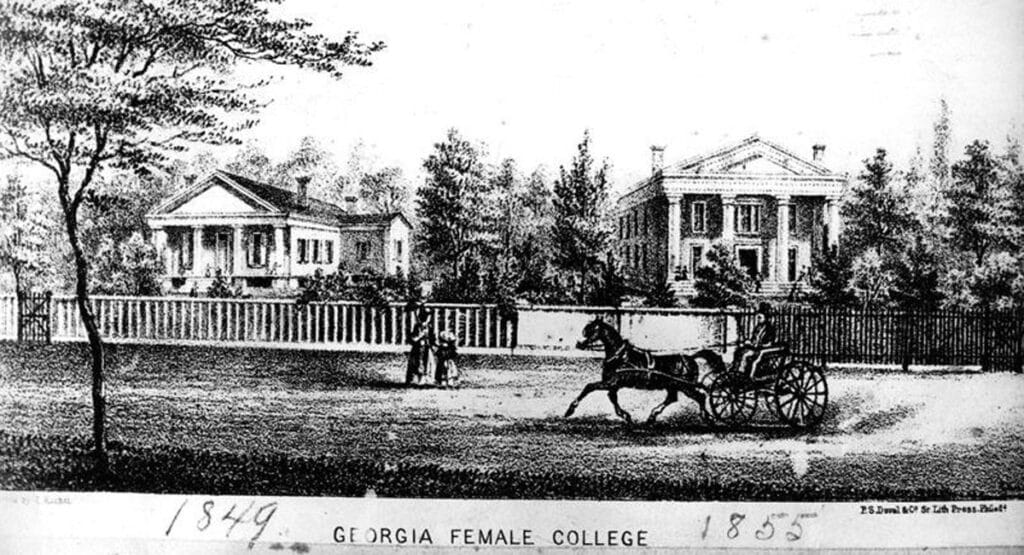
Within the city of Madison, education was a large focus and Madison soon became known as the “most cultured and aristocratic town on the stagecoach route from Charlestown to New Orleans.” Private academies as well as two female colleges – the Madison Collegiate Institute and the Madison Female College – made the area an important center for education.
The Madison Collegiate Institute (later known as the Georgia Female College) was founded in 1849 as one of the first women’s colleges in the United States. Even though the Georgia Female College no longer exists, the Baldwin-Ruffin-Lanier House still stands as the original classroom building for the school. The main classroom, to the right of the house, is no longer there due to fire damage, but the Foster-Thomason-Miller House was built on its foundations. Visitors can traverse these historic sites through the self-guided walking tour.
The Madison Female College, otherwise known as the Methodist College, provided an education for young women from 1850 until the 1860’s. The college included a public library and often hosted important town events, showcasing the holistic importance of educational spaces in Morgan County.
Education was limited to the white population, as in Georgia, teaching an enslaved person to read was outlawed in 1770 and in 1829 the law was expanded to include free men and women of color. In the aftermath of the Civil War, the Freedmen’s Bureau was established by Congress to assist former enslaved persons in the South. In 1867, the Bureau rented the former Madison Baptist Church to open the first school for African Americans in Madison.
Revolutionaries Who Made Morgan County Home
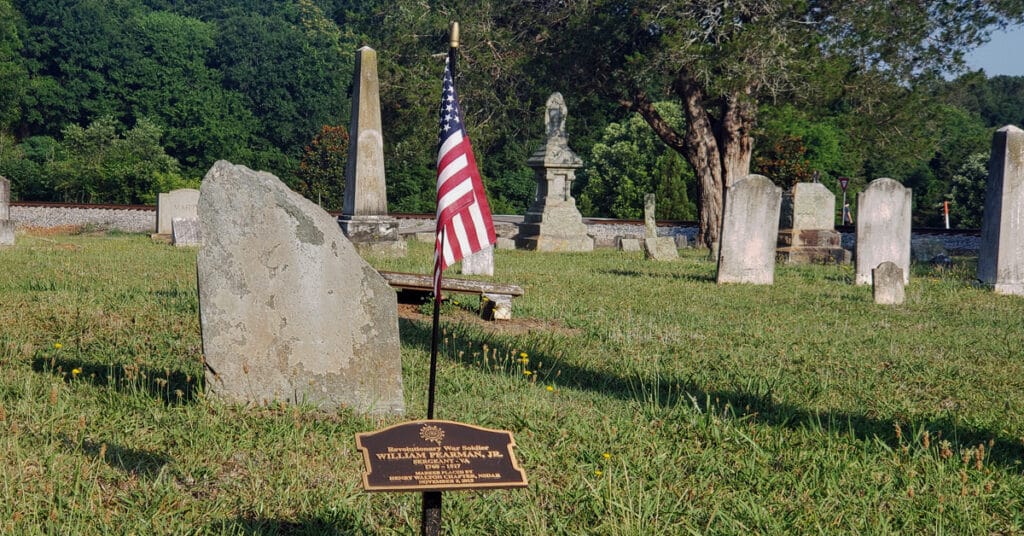
Although they are no longer with us, the stories of the Revolutionary War veterans only grow more important. Discover the names and histories of those who gave their lives to the cause of ensuring independence for the United States. As noted by The Magazine Antiques, 62 settlers of Morgan County served under the well-respected Revolutionary War General Daniel Morgan. However, not all of these settlers are known by name, and there are others we know lived and/or worked here during their lives.
The following individuals are recognized as American Revolutionary War veterans who lived in Morgan County at one point in time: David Allen, William Arrington, Lewis B(r)andy, William Barkley, Samuel Bellah, Edmund Carlisle, Matthew Cockrum, Joseph Collins, Malekiah Culpepper, Josiah Dennis, John Duck, Thomas Dukes Sr., William Evans, William Feagans Sr., Nathan Formb Sr., Herod Gibbs, William Gilbert, John M. Giles, Robert Greer, Francis Guttery, James Hale, Graves Harris, John G. Heard Sr., John Hendley, Christopher Irwin, Robert Jackson, Elisha Jarvis Sr., William Johnson, William Lane Sr., Jesse Lee, David Maddin, William McCullers, William McKinsey, John Morgan Sr., Ewing Morrow, James Myhand Sr., John Neally, George Norwood, Daniel Parker Sr., Edmund Peters, Edmund Rains, Isaac A. Roy, John Rucker Sr., John Smith Sr., Lawrence Smith, Leaven Smith, William Smith, Richard C. Taylor, Charles Weeks, Lewis Wheelous Sr. and Lewis Yarborough.
A special thanks to the Morgan County Archives for providing a majority of the resources used to research the histories of many Revolutionary War veterans.
Revolutionary War Soldiers Buried in Madison
Old Cemetery
John Jackson Cooper: John Jackson Cooper served as a private in the Revolutionary War, specifically within the Henry County VA Militia. He later served in the GA Continental Line. John Cooper may have participated in the 1807 lottery, drawing land lot 288 in current-day Morgan County. However, Cooper certainly received bounty land and drew land in the 1827 GA Land Lottery. Cooper was laid to rest in the Old Cemetery in Madison, GA.
Thomas Norris: Born in Maryland in 1756, Norris served as a private in the 1st Company Maryland Regiment and moved to Wilkes County, Georgia in 1786. Norris may have migrated to Morgan County due to a draw in the 1807 lottery where he received a full lot in current-day Morgan County. Norris had farmland in Morgan County while also operating as an attorney and manufacturer and purchased the Rogers House in 1817. He was married to Sarah Ann Billingslea and had two children. Norris is buried in the Old Cemetery alongside his daughter and five great-grandchildren.
William Pearman Jr.: Born in Virginia circa 1760, Pearman enlisted as a Sergeant in the 3rd Company Virginia Regiment in 1778, with his father also serving through donating supplies. Pearman moved to Wilkes County in 1786 and worked as a farmer on almost 2,000 acres until his death in 1817. He and his wife, Isabel Steward Weakley, had five children together. After his passing, his wife moved to Madison. Pearman and Isabel are buried together at the Old Cemetery.
Braswell Park
Benjamin Braswell: Benjamin Braswell, born in 1749, remains relatively unknown due to the lack of information regarding his early life. However, Braswell’s legacy remains incredibly valuable to Morgan County. Although unclear, Braswell’s tomb deems him a patriot, indicating Revolutionary War service. Before his passing in 1817, Braswell completed a will strongly emphasizing the seizing of his assets to the poor and unfortunate. Thus, the Braswell Fund was created in support of orphan children in the area. Over the years, the fund only continued to grow, even contributing to this day. Braswell’s grave lies in the back of Braswell Park next to that of his wife, Emily, serving as a landmark for his permanent impact on Morgan County.
Swords Community Cemetery
Johannes “John” Dingler: The life of Johannes Dingler is nothing short of patriotic. Born in Germany in 1759, Dingler likely arrived in the colonies around 1776 as part of a German effort to support their British ally. Along with thousands of others, Dingler was meant to serve alongside the Loyalist forces. However, in August of 1779, he deserted to the American forces and served as a dragoon – a mounted soldier. After the battle, Dingler married Nancy Paschall and had four children. Ultimately, they relocated to the newly-formed Morgan County where Johannes Dingler would pass away in 1816. His cenotaph is located at Swords Community Cemetery in Buckhead, Morgan County.
Mitchem Cemetery
Jeremiah Sparks: Born in 1760, Jeremiah Sparks served as a private in the NC Line during the American Revolution and is noted as a Morgan County pioneer. Sparks, at one point, was married to Mary, and throughout his lifetime, he had at least four children. Appearing in the 1820 census for Morgan County, Sparks also served as Justice of Peace. Jeremiah Sparks passed away in 1840, and his final resting place is within the Mitchem Cemetery in Madison.
Revolutionary War Soldiers Buried in Morgan County
James Fannin: Born in Virginia in 1739, Fannin dedicated much to the Revolutionary War, as he provided his services through commanding the 1st Georgia Reserves (consisting of 10 companies). Eventually settling in Greene County, Fannin reportedly ensured that his wife – Elizabeth Saffold – and children were afforded every available opportunity. He passed away in 1803, but his legacy lives on.
James Fielder: Born in Virginia in 1750, James Fielder was the second son of his family and served multiple years in the Revolution and took an Oath of Allegiance. Near the war’s completion, Fielder married Sally Benge, moving first to South Carolina, then to Greene County and, finally, Morgan County. His move may have been due to his participation in the 1807 lottery, in which he won a full lot of land in current-day Morgan County. Although Fielder passed away in 1813, his story remains known due to his grandson’s writings in his “Family Record” booklet.
Pvt George Haynes: Private George Haynes was born in Virginia in 1734. Along with serving in the Revolutionary War for the VA Militia, Haynes also demonstrated his patriotism through serving in the French and Indian War and signing an Oath of Allegiance. Additionally, he was married to Lucy Ann Phelps. Haynes passed away in 1810 and lies in a private family cemetery in Madison, GA.
John Adair: Born in South Carolina in 1756, Adair served as a private in the SC Militia. Adair and his wife, Jane Fisher Jones, had 12 children together – one of which would also become a veteran. The Adair legacy can be traced back to his grandparents, born around 1710. John Adair passed away in 1812 in Morgan County. His burial spot includes a hand-carved headstone located within a private cemetery.
John Akins: John Akins was born in Maryland in mid-1760 and enlisted in the Revolutionary War as a soldier in North Carolina. Akins and his wife, Mary Kaigler, eventually settled in Morgan County as the parents of six children. During the first Georgia land lottery in 1805, Akins received a full lot of 202.5 acres in current-day Morgan County. John Akins passed away in 1839 and lies in a private family cemetery in Morgan County, GA.
Rev Peyton Wade Sr.: Rev Peyton Wade Sr. was born in Virginia in 1755. He served as a private in Captain William Witcher’s Company of the VA Troops while also pledging an Oath of Allegiance to Virginia. Wade Sr. was married to Sarah May Maner and Martha Perkins and had seven children. He passed away in 1831 and now lies in a private cemetery in Morgan County.
Benjamin Fitzpatrick: Fitzpatrick famously gave the town of Buckhead its name by marking a tree with the head of a buck. Born in 1748 in Goochland, VA, Fitzpatrick served as a private in the American Revolution. During his lifetime, he married Mary Perkins and Sarah Jones and was a father to three children. In the 1805 land lottery, Fitzpatrick won a fraction of a lot in current-day Morgan County, located along the border of Greene County. He now lies in a private family cemetery in Buckhead, GA.
William Bostwick: Born around 1750-52 in Delaware, William Bostwick served as a Soldier in Georgia during the Revolutionary War. Additionally, he may have received a lot of land in the 1807 lottery for current-day Morgan County. Bostwick was married to Mary Bailey and passed away in 1811 in Morgan County and is buried in Bostwick.
James Houston Jr.: Born in 1755 in Ireland, James Houston Jr. served as a Soldier in Georgia during the Revolutionary War. Houston was married to Mary Hughey, with whom he had nine children, and marked as a resident of Morgan County in the 1827 Lottery. Houston passed away in 1837 in Morgan County and is buried in a private cemetery in Morgan County.
Reuben Radford: Radford was born in 1754 and served as a Soldier in the Virginia Militia during the Revolutionary War. Radford was married to Elizabeth Hackworth, with whom he had nine children, and passed away in 1819 in Morgan County. He is memorialized and buried in a private family cemetery near Bostwick.
John Walker: Born in 1760 in Georgia, Walker served as a Soldier in Georgia during the Revolutionary War. Walker was married to Frances Byne and had four children. He may have won a lot of land in current-day Morgan County during the 1805 lottery. He died in 1836 in Morgan County and is buried in a private family cemetery.
William West: Born in 1762 in Virginia, William West was a private in the Virginia Continental Line during the Revolution. West was married to Alice Egmon and passed away in 1830. His final resting place is within a private family cemetery near Madison, Georgia.